The Ultimate Digital Nomad Packing List: Tech & Gear for Long-Term Travel

Transitioning to a location-independent lifestyle requires a highly optimized digital nomad packing list focused on weight reduction, redundant tech backups, and versatile apparel. This comprehensive guide details the precise gear, electronics, and clothing needed to live and work globally out of a single carry-on bag. By prioritizing dual-purpose items and strict weight limits, you can eliminate checked baggage fees and work productively from any destination.
Living and working from the road is no longer a niche lifestyle choice; it is a highly structured professional endeavor. The boundary between a chaotic trip and a seamless remote work experience lies entirely in your preparation. A disorganized suitcase leads to missed deadlines, damaged electronics, and physical fatigue. Conversely, a minimalist, highly functional digital nomad packing list empowers you to move between climates and time zones without friction.
Contents
- Key Takeaways
- The Anatomy of a Perfect Nomad Backpack
- The Core Tech Ecosystem: Hardware and Peripherals
- Ergonomics on the Road: Preventing Chronic Pain
- The Minimalist Wardrobe: Fabrics and Layering
- Organization and Packing Systems
- Health, Hygiene, and Personal Care
- Security, Documents, and Financial Backups
- Common Mistakes to Avoid
- Frequently Asked Questions
Key Takeaways
- Prioritize a strict 10kg carry-on limit to remain mobile and avoid budget airline baggage fees globally.
- Invest in a dual-purpose USB-C ecosystem to charge your laptop, phone, and peripherals with a single plug.
- Choose merino wool and technical fabrics to minimize clothing volume while maximizing wear time between washes.
- Maintain physical health on the road by packing a lightweight, ergonomic laptop stand and external keyboard.
The Anatomy of a Perfect Nomad Backpack
Your choice of luggage dictates your entire travel experience. When your life fits into a single bag, that bag must be durable, weather-resistant, and compliant with strict international carry-on dimensions. Checking a bag is a major liability for digital nomads: it increases the risk of lost work equipment, adds hours of waiting at baggage carousels, and incurs substantial fees on regional carriers.
Carry-On Only vs. Checked Baggage
For long-term travel, a carry-on bag in the 35L to 45L range is the optimal sweet spot. This size easily fits into overhead compartments on major commercial airlines and most regional budget carriers. Keeping your gear with you prevents the catastrophic loss of your primary income-generating tools—your laptop and camera gear. It also forces you to curate your possessions, ensuring you only carry what is absolutely necessary for your daily survival and professional output.
Top Luggage Recommendations for Remote Workers
When selecting a backpack, look for features such as a dedicated, padded laptop compartment with external access, a clamshell opening design that allows you to pack it like a suitcase, and stowaway shoulder straps for tight spaces. High-density nylon fabrics, such as 1680D Ballistic Nylon or Sailcloth (X-Pac), offer excellent water resistance and tear protection. Brands like Peak Design, Nomatic, and Aer produce industry-standard travel packs specifically engineered for mobile professionals.
The Core Tech Ecosystem: Hardware and Peripherals
Your technology is your livelihood. A professional digital nomad packing list must treat electronics not as travel accessories, but as critical business infrastructure. If a piece of hardware fails in a remote coastal village, you need to have an immediate backup plan or a highly resilient setup.
Choosing the Right Laptop for Remote Work
Your laptop is the centerpiece of your remote work setup. It must balance processing power, battery life, and weight. For creative professionals editing video or writing code, machines like the Apple MacBook Pro or high-end Dell XPS units are standard. For writers, marketers, and administrative professionals, a lighter machine like the MacBook Air or a Lenovo ThinkPad offers exceptional battery life and reliability. Aim for a machine that can deliver at least 8 to 10 hours of active battery life to survive long flights or power outages in developing regions.
Power Delivery and the Single-Charger Philosophy
Gone are the days of carrying a tangled mess of proprietary power bricks. Modern digital nomads rely on Gallium Nitride (GaN) chargers. These chargers utilize advanced semiconductor material to deliver high wattage in a fraction of the physical size of traditional silicon chargers.
Why GaN Chargers are Essential
A single 100W or 140W GaN charger with multiple USB-C ports can simultaneously charge your laptop, tablet, smartphone, and wireless headphones. This eliminates duplicate power bricks and reduces your overall pack weight by up to two pounds. Pair this with high-quality, braided USB-C cables rated for 100W power delivery to ensure safe, rapid charging cycles.
Backup Power and Universal Connectivity
A high-capacity power bank is non-negotiable for working on the move. Look for a battery pack with a capacity of 20,000 to 25,600 mAh that supports at least 65W Power Delivery (PD) output. This allows you to charge your laptop directly when power outlets are unavailable. Note that the Federal Aviation Administration and international aviation authorities limit lithium-ion batteries to 100 watt-hours (Wh) in carry-on baggage, so ensure your power bank clearly displays its capacity ratings to avoid confiscation at security checkpoints.
Ergonomics on the Road: Preventing Chronic Pain
Working from coffee shops, airport lounges, and poorly designed Airbnb dining tables will quickly take a toll on your posture. Ergonomic injuries are one of the most common reasons digital nomads cut their travels short. Your digital nomad packing list must include lightweight tools to recreate a healthy workstation anywhere in the world.
Portable Laptop Stands
A portable laptop stand elevates your screen to eye level, preventing the forward-head posture that causes neck and shoulder strain. Look for collapsible stands made of carbon fiber or aircraft-grade aluminum, which fold down to the size of a small umbrella and weigh less than six ounces. The Roost Stand and the Nextstand are highly regarded options in the nomad community.
Compact Input Devices
When your laptop is elevated on a stand, you will require an external keyboard and mouse. A minimalist setup includes a low-profile mechanical or membrane keyboard and an ergonomic travel mouse. These peripherals should support multi-device Bluetooth pairing, allowing you to switch seamlessly between your laptop, tablet, and smartphone without carrying extra wireless dongles.
| Device Name | Weight Category | Connectivity | Best For |
|---|---|---|---|
| Logitech MX Keys Mini | Mid-weight | Bluetooth & Bolt Receiver | Quiet typing, multi-device switching |
| Apple Magic Keyboard | Ultra-light | Bluetooth | macOS integration, flat profile |
| Logitech MX Anywhere 3S | Lightweight | Bluetooth & Receiver | Tracking on any surface (including glass) |
| Keychron K3 Ultra-Slim | Heavy | Bluetooth & Wired | Tactile typing, mechanical switch lovers |
The Minimalist Wardrobe: Fabrics and Layering
Packing for long-term travel across multiple climate zones requires a strategic approach to apparel. The secret lies not in packing more clothes, but in selecting high-performance fabrics that resist odors, dry quickly, and layer efficiently. This allows you to pack less than a week's worth of clothing while remaining comfortable in both tropical and temperate environments.
The Power of Merino Wool
Merino wool is the undisputed gold standard fabric for digital nomads. Unlike synthetic fibers or cotton, merino wool fibers have a natural protective outer layer that prevents bacteria from absorbing into the fabric, making it highly odor-resistant. A merino wool t-shirt can easily be worn multiple times without washing, significantly reducing the volume of clothing you need to pack. Additionally, merino wool regulates body temperature exceptionally well, keeping you cool in the heat and warm in the cold.
Technical Synthetics vs. Cotton
Cotton should be minimized on your digital nomad packing list. It absorbs moisture, takes a long time to dry, and wrinkles easily. Instead, opt for technical synthetics such as nylon, polyester, and elastane blends. These fabrics are engineered for durability, offer built-in stretch for travel comfort, and can be hand-washed in a sink and hung dry in a few hours.
The Capsule Wardrobe Blueprint
A functional capsule wardrobe consists of versatile pieces that can all be interchanged. Stick to a neutral color palette (blacks, grays, navy, and olive) to ensure every top matches every bottom. This simple strategy allows you to create dozens of unique outfits from just a few key items.
Sample Male Capsule Wardrobe
- 3 Merino wool t-shirts (black, gray, navy)
- 1 Button-down technical travel shirt
- 2 Pairs of lightweight, technical stretch trousers
- 1 Pair of hybrid swim shorts (dual-purpose casual/swim)
- 5 Pairs of merino wool socks
- 5 Pairs of moisture-wicking synthetic underwear
- 1 Packable rain shell
- 1 Lightweight down jacket or active mid-layer
Sample Female Capsule Wardrobe
- 3 Merino wool or modal t-shirts/tanks
- 1 Lightweight long-sleeve button-down or blouse
- 1 Pair of technical travel pants or stretch trousers
- 1 Pair of high-quality leggings (for travel and fitness)
- 1 Versatile travel dress or jumpsuit
- 1 Mid-length skirt or hybrid shorts
- 5 Pairs of merino wool ankle socks
- 5 Pairs of seamless, quick-dry underwear
- 1 Packable wind and rain jacket
- 1 Lightweight cardigan or merino wool sweater
NEW — AI Snap & Check: photograph your packed bag and OneBag's AI instantly ticks off your items and warns you about missing essentials (passport, wallet, charger). Plus smart carry-on lists for your exact trip and bag-weight tracking for 80+ airlines — so you never forget a thing or pay an overweight fee.
Organization and Packing Systems
Without a structured packing system, even the most curated digital nomad packing list will quickly devolve into a chaotic mess inside your backpack. Organizing your gear into modular compartments protects your belongings and makes packing and unpacking incredibly fast.
Compression Packing Cubes
Compression packing cubes are essential for maximizing space. Unlike standard packing cubes, compression cubes feature a secondary zipper system that expels excess air from your clothing, reducing the volume of your apparel by up to 40%. Use one cube for tops, one for bottoms, and a smaller, breathable cube for undergarments and socks.
Tech Pouches and Cable Management
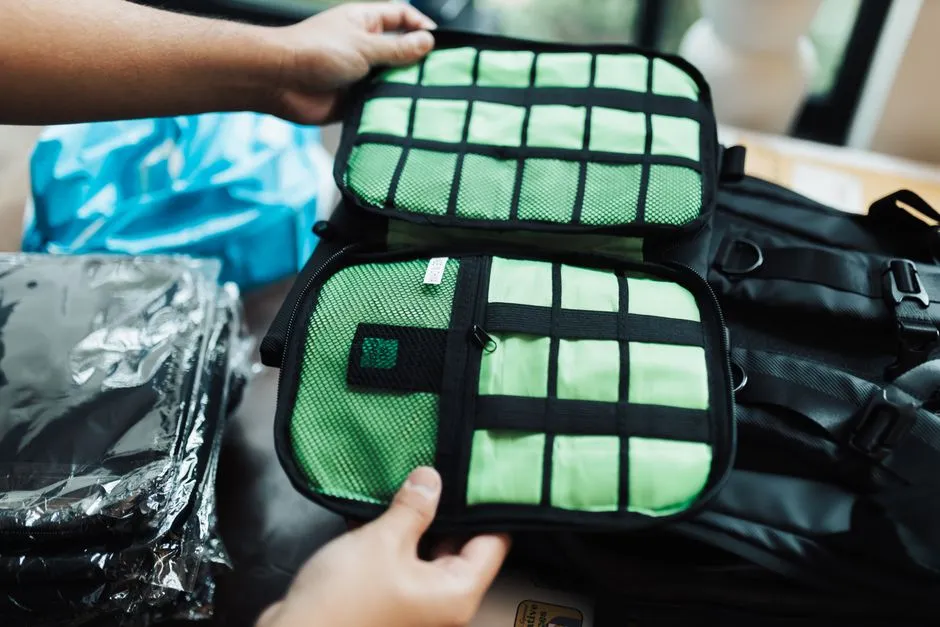
Your expensive cables, adapters, memory cards, and dongles should never be thrown loosely into your bag. A dedicated, padded tech pouch keeps your digital life organized. Look for pouches with elastic loops, zippered mesh pockets, and structured dividers. This ensures you can locate any cable instantly and prevents delicate wires from bending or fraying during transit.
Health, Hygiene, and Personal Care
Maintaining your health and hygiene on the road is vital for sustaining long-term travel. Your toiletry kit should be compact, leak-proof, and fully compliant with international liquid restrictions for carry-on baggage.
The Solid Toiletry Revolution
The easiest way to bypass airport security liquid limits (the 100ml rule) is to convert your liquid toiletries into solid alternatives. Solid shampoo bars, conditioner bars, solid deodorants, and toothpaste tablets work just as well as their liquid counterparts, last longer, and will never leak inside your expensive backpack.
First-Aid and Prescription Management
Always carry a basic medical kit tailored for travel. This should include broad-spectrum antibiotics (prescribed by your travel doctor before departure), pain relievers, antihistamines, rehydration salts, and motion sickness medication. Keep all prescription medications in their original packaging with your name clearly printed on the label, and carry a digital copy of your prescriptions on your phone to avoid issues at international borders.
Security, Documents, and Financial Backups
Losing your passport, credit cards, or travel documents can halt your journey instantly. A robust security strategy involves physical protection and digital redundancies to safeguard your identity and financial assets.
Physical Document Protection
Keep your physical passport, vaccination records, and spare emergency cash in a RFID-blocking passport pouch or a hidden pocket inside your backpack. It is highly recommended to carry at least two physical copies of your passport photo page: keep one in your main luggage and another in a separate daypack.
Digital Redundancy and Cloud Backups
Before departing, scan all essential documents—including your passport, driver's license, travel insurance policy, and health cards—and store them in an encrypted, password-protected cloud folder. Additionally, use a secure password manager to store your login credentials, and enable two-factor authentication (2FA) on all accounts. Avoid SMS-based 2FA where possible, as changing international SIM cards can lock you out of your accounts; use authenticator apps or physical security keys instead.
Financial Redundancy on the Road
Never travel with only one debit or credit card. If a local ATM eats your card or a bank flags your card for suspicious activity, you need immediate alternatives. Carry at least two debit cards and two credit cards from different banking institutions. Look for accounts that offer fee-free international ATM withdrawals and cards with no foreign transaction fees to save hundreds of dollars annually.
Common Mistakes to Avoid
- Overpacking heavy cotton clothing: Cotton absorbs sweat, smells quickly, and takes days to dry in humid climates. Replace it with merino wool or technical synthetics.
- Carrying duplicate cables and chargers: Packing individual power bricks for your phone, laptop, and camera adds unnecessary weight. Consolidate your power needs with a single multi-port GaN charger.
- Neglecting physical ergonomics: Working directly on a laptop for months leads to neck strain and repetitive strain injuries. Always travel with a collapsible laptop stand, external keyboard, and mouse.
- Forgetting to check carry-on weight limits: Many budget airlines strictly enforce a 7kg (15 lbs) or 10kg (22 lbs) weight limit for carry-on bags. Always weigh your fully packed bag before heading to the airport.
- Relying on a single financial card: If your sole debit card is lost or blocked, you will be stranded without cash. Carry multiple backup cards and store them in separate bags.
Frequently Asked Questions
What is the absolute maximum weight my digital nomad backpack should be?
Your fully packed backpack should ideally weigh no more than 10 kilograms (22 pounds). This weight limit is the standard threshold for most international airlines' carry-on policies. Keeping your pack under this weight ensures you can travel freely without paying expensive checked bag fees, avoids physical strain on your back, and allows you to walk long distances comfortably when navigating transit hubs.
How do I handle laundry while traveling long-term?
Long-term travelers rarely carry more than 7 to 10 days' worth of clothing. To manage this, plan to do laundry once a week. You can utilize local laundromats, use affordable wash-and-fold services common in digital nomad hubs, or hand-wash your quick-drying technical garments in your accommodation's sink using a concentrated travel liquid soap or laundry sheets.
Can I bring a power bank on an airplane?
Yes, you can bring power banks on airplanes, but they must be packed in your carry-on baggage. Airlines and airport security strictly prohibit lithium-ion batteries in checked luggage due to fire safety hazards. Additionally, the power bank's capacity must not exceed 100 watt-hours (approximately 27,000 mAh) unless you have prior airline approval.
How do digital nomads secure reliable internet access?
Reliable internet is the lifeline of remote work. Successful nomads research the Wi-Fi speeds of their accommodations beforehand, use local SIM cards or travel eSIMs for cellular backup, and carry a portable mobile hotspot device. Many also select co-working spaces with redundant fiber-optic connections to guarantee uninterrupted access during critical video calls.
Should I buy travel insurance or international health insurance?
Standard travel insurance is designed for short trips and covers trip cancellations, lost luggage, and emergency medical care. If you are living abroad long-term, you should invest in specialized international health insurance or digital nomad health insurance. These plans are designed for continuous global coverage and cover routine medical care, dental work, and long-term treatments.
How do I keep my physical passport safe while traveling?
When transit days are over, keep your physical passport locked in your accommodation's safe or a secure, lockable compartment inside your backpack. When carrying it with you during travel days, use an RFID-blocking passport holder worn close to your body. Always keep digital, encrypted copies of your passport on your phone and cloud storage for emergency situations.
Crafting the perfect digital nomad packing list is an evolving process of trial, error, and refinement. By focusing on high-quality, multi-functional gear, minimizing physical weight, and maintaining strict digital and financial redundancies, you can transition into a location-independent lifestyle with complete confidence and professional efficiency.

Independent Full Stack Developer · Founder of Tabserve
Aycan builds and maintains Tabserve's apps — OneBag, Routevia and RentFlow — and writes practical, tested guides to help you pack smarter, travel better and manage rentals with less hassle.